Why This Mapping?
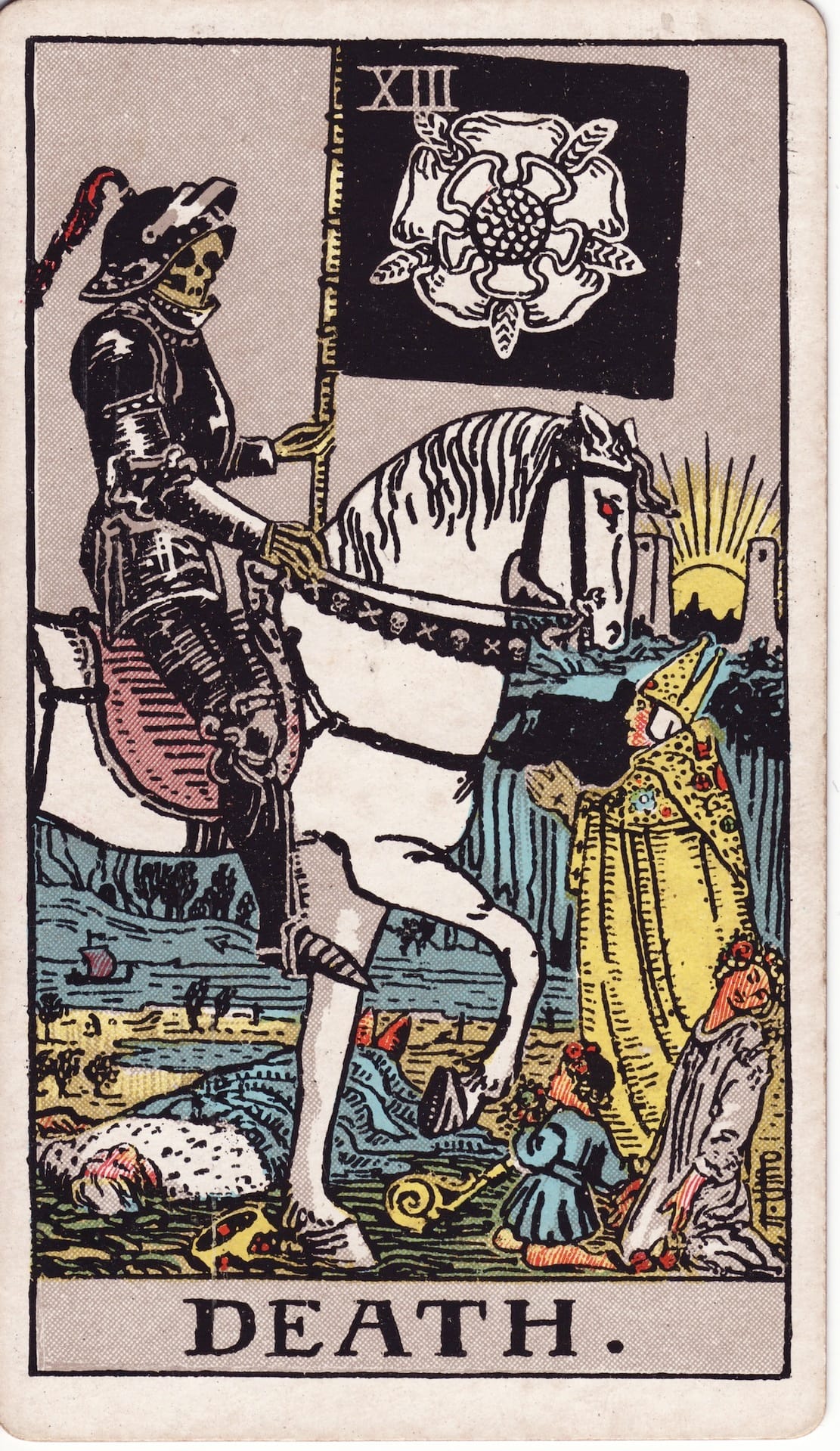
The Death card in Tarot rarely signifies physical death; rather, it represents profound transformation, the irrevocable end of a specific phase of life, and the birth of a new state of being. Just as McInerny argues that we do not "move on" (return to our former selves) but rather "move forward" (integrate the loss into a new version of ourselves), the Death card signifies that the old self has been dismantled and cannot be resurrected in its previous form, necessitating a painful but essential evolution.
▶READ MORE ABOUT WHY THIS MAPPING...
Grief as a Fundamental Transformation
McInerny’s central thesis is that grief changes who we are fundamentally, rather than being a temporary obstacle we overcome to return to "normal." Similarly, the Death card is described not as a literal ending of life, but as a "change in the form of consciousness". It represents a "transformative process" where the old personality or ego is "dismembered" or shattered, making it impossible to return to the former way of life. As author Sallie Nichols notes, the figure in the Death card faces a "break between the old and the new" and "can never again return to his former ego-centered personal life".
Renaming the Card "Grief"
Modern interpretations explicitly link this card to the grieving process. Michelle Tea suggests that the Death card "would benefit from being renamed Grief, or Mourning, for that is the real heart of the card". She explains that when this card appears, a time of processing is required where one must consciously let go of what was, acknowledging that "you are becoming a new person". This mirrors McInerny’s sentiment that grief is an active state of becoming, rather than a passive waiting period for things to return to how they were.
The Concept of "Moving Forward With It"
The visual symbolism of the Death card often includes a sunrise on the horizon, indicating that while a chapter has definitively closed, a new day is dawning. This aligns with the concept of moving forward. The card teaches that "what dies also lives," meaning that while the person or situation is gone, the energy is reborn or resurrected in a new form. The "king is dead: long live the king" sentiment found in the card suggests that the griever must integrate the loss and carry it forward into their new identity, rather than trying to resurrect the version of themselves that existed prior to the loss.
Rejection of "Moving On"
McInerny rejects the idea of "moving on" because it implies leaving the person behind. The Death card supports this by illustrating that transformation is not about erasure but about a necessary evolution. It is a "liberation" and a "renewal" that requires the individual to face the reality of the loss without "tiptoeing around" it or using euphemisms. The card demands an "unflinching" look at the present moment, validating that the deep, structural change caused by grief is the mechanism for the new life that follows.