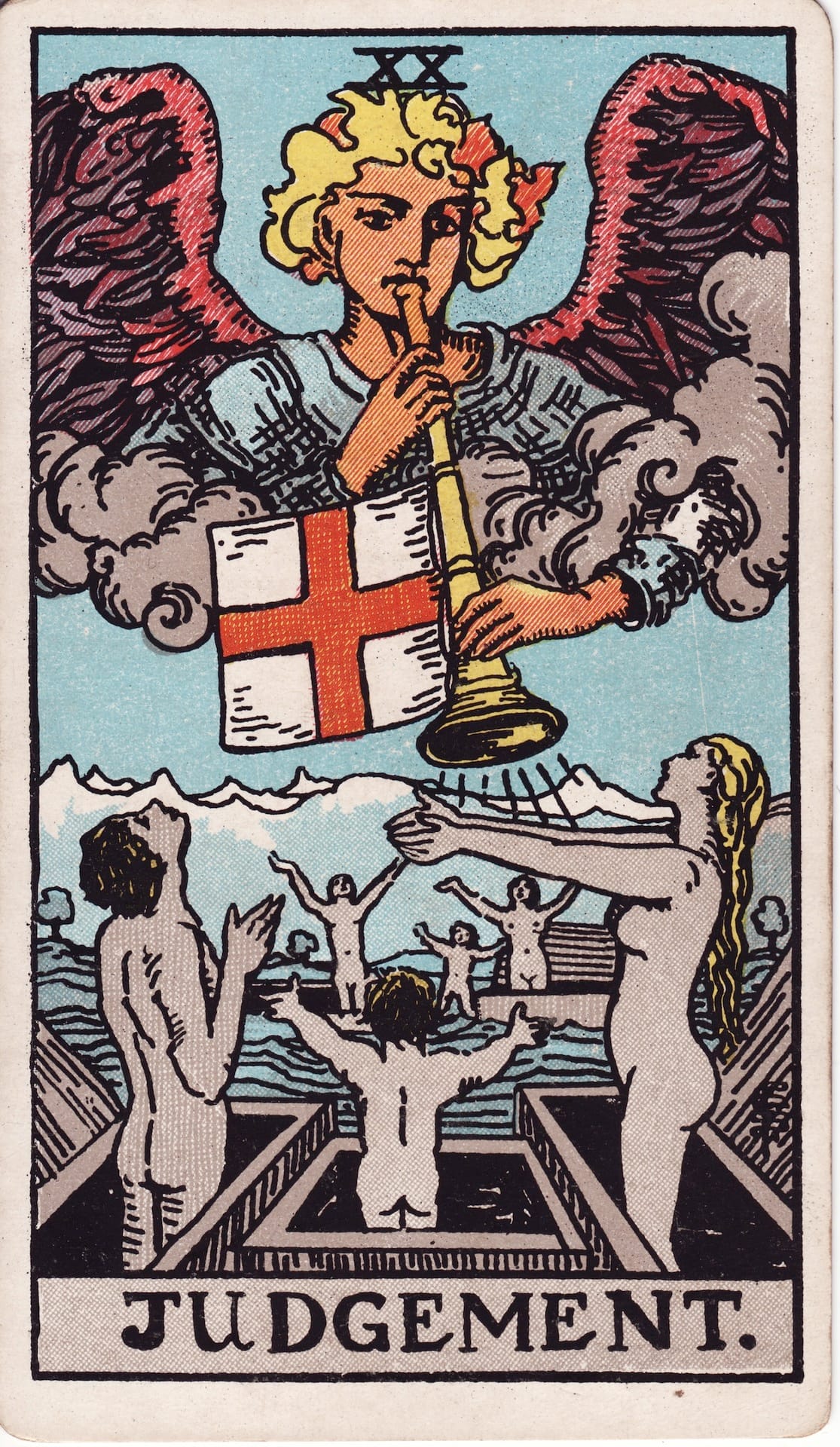
Judgement
Judgement represents a spiritual awakening and a call to rise to a higher level of existence. It signifies the need to make a major decision, forgive the past, and embrace a new life.
rebirthawakeningabsolutioncallinginner voicerenewaldecision

Featured Talk
Are we celebrating the wrong leaders?
Martin Gutmann
202416 min
“Martin’s brilliant talk functions as a collective wake-up call. Like Judgement, it isn’t about punishment or blame... it’s about recognition. He names a long-running pattern (celebrating the wrong leaders), sounds the trumpet of awareness, and invites us to choose differently now that we can see what we’ve been doing.”
▶READ MORE ABOUT WHY THIS MAPPING...
Judgement appears when a cycle of unconscious behavior has been fully lived and is ready to be re-evaluated in the light of awareness. That is precisely the role Gutmann’s talk plays.
Here’s how the archetype maps, layer by layer:
1. Judgement = Seeing the Pattern All at Once
Judgement isn’t incremental learning; it’s a threshold moment. The figures rise from coffins because something previously buried is now undeniable.
Gutmann doesn’t scold individual leaders, doesn’t argue policy, reveals the meta-pattern of what we reward as “leadership”.
This is Judgement energy: “Now that you see it, you can’t unsee it.”
2. The Trumpet, Not the Verdict
In tarot, Judgement is often misread as moral reckoning. In truth, it’s about clarity, not condemnation. The angel doesn’t decide for anyone... the call simply sounds.
Gutmann mirrors this posture. He doesn’t say “these leaders are evil”, he says “here’s what we’ve been celebrating—and why”. And responsibility returns to the audience, not the speaker.
That transfer of agency is quintessential Judgement.
3. Collective, Not Personal
Judgement is rarely about one person’s psychology. It operates at the systems and culture level... families, institutions, civilizations.
Gutmann’s focus is collective... evolutionary incentives, organizational selection pressures, cultural myths of strength and dominance.
This is not Devil (entanglement) or Emperor (authority) alone... it’s the moment the group realizes what story it has been living inside.
4. From Unconscious Loop to Conscious Choice
Judgement marks the transition from compulsion to choice.
Before Judgement: “This is just how leadership works”
After Judgement: “Oh… we are choosing this. We could choose otherwise.”
Gutmann doesn’t prescribe the future in detail—that’s not Judgement’s job. Judgement’s work is simpler and more profound: restore moral and cognitive agency.
5. Judgement as Cultural Midpoint
In the Major Arcana sequence, Judgement comes after The Devil and The Tower. It is what happens once the spell is broken and the collapse has been witnessed.
Read this way, Gutmann’s talk assumes:
> We’ve already seen leadership failures
> We’ve already felt the consequences
> Now comes the reckoning: What are we going to do with what we know?
That’s Judgement... its not destruction, not hope yet, but reckoning with awareness.
6. The Core Question Judgement Asks
Every Judgement card asks: “Who are you now that you know this?”
Gutmann asks the same, implicitly:
> Who do you promote?
> Who do you trust?
> What traits do you reward when no one is watching?
The talk doesn’t end with answers... it ends with responsibility returned to the listener, which is exactly where Judgement leaves us.
More Talks for This Card
My philosophy for a happy life
Sam Berns
201312 min